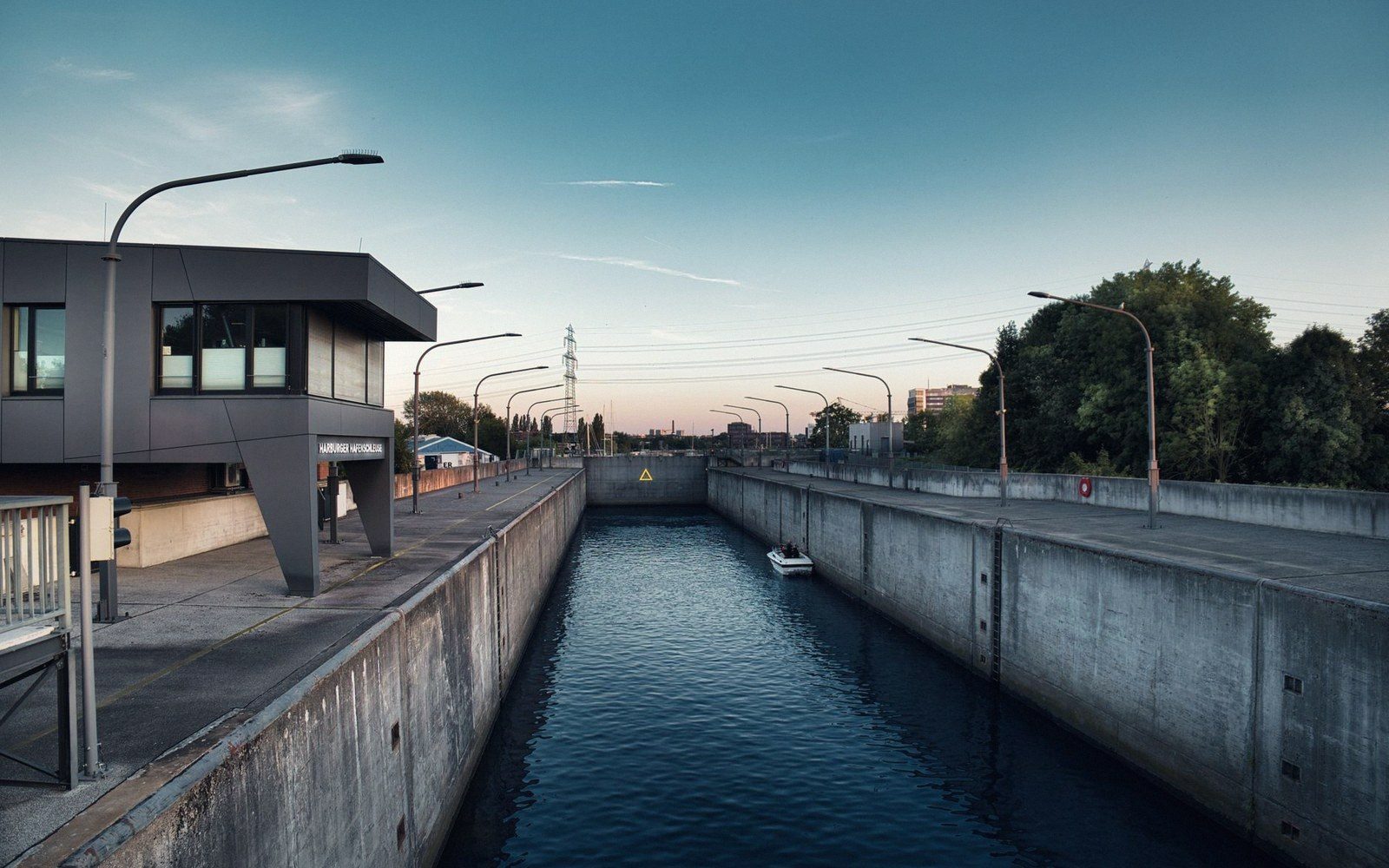
A sealed room in the water, working the gap between river and sea
Tidal locks are among the less visible pieces of infrastructure that keep port cities connected to the ocean. They sit between a tidal river or harbour and a dock basin held at a fixed level — and they exist for one reason: the tide goes up and down, and the dock cannot.
Without a lock, a ship in a basin open to the tide would rise and fall with the sea. Berths would become unusable at low water, cranes and loading gear would face a perpetually moving target, and the fine tolerances of modern cargo handling would collapse. So a dock basin is impounded — sealed off and held at a roughly constant level — and everything that enters or leaves must pass through the lock chamber, a watertight box with gates at each end that allows two bodies of water at different heights to exchange traffic without exchanging water.
Gates, sills and the arithmetic of the tide
The most recognisable part of a tidal lock is its gate. In most working port locks these are mitre gates — two angled leaves that meet in a shallow V shape pointing upstream (or toward the higher water). The V matters because water pressure drives the gates tighter together the harder it pushes, which is elegant engineering: the lock seals more firmly the greater the head of water against it. Larger locks sometimes use single sector gates, which swing on a vertical pivot and take up less width, or rising sector gates built into the sill, which lower flat to allow deep-draughted vessels to pass over them. The sill itself — the bottom threshold of the gate opening — sets the minimum water depth available, and a ship whose draught approaches the sill depth must wait for higher water before entering.
When a vessel approaches from the river side, the port's lock master checks the current levels on both sides. If the river is close to the dock level, the gates can open almost immediately. If the tide is low and there is a significant difference — which at a port like Bristol's Avonmouth can be several metres on a large tide — the chamber must be used in full.
The sequence runs like this. The outer gates, facing the river or estuary, are closed. Water enters the chamber through sluices built into the gate structure or the lock walls: small openings, sometimes just paddles or culverts, that let water flow between the chamber and one side. The flow is deliberately restricted. If the chamber filled quickly, the turbulence would push the ship around on its lines. Instead, the sluices are opened gradually, and the ship — held by its mooring lines to the lock wall — rises or falls gently as the level equalises. The crew tends the lines throughout, easing them as the ship lifts or taking in slack as it drops, keeping the vessel positioned and controlled. This is mooring lines under load in a compressed and active form: the forces are modest compared to a storm berth, but the geometry is constantly changing.
Why it takes the time it takes
The time a lock passage requires is not arbitrary. A large lock chamber — say, two hundred and fifty metres long and thirty-five metres wide — holds an enormous volume of water. Even with sluices open and water flowing freely, equalising a difference of four or five metres takes time. The flow rate through a sluice is governed by the cross-sectional area of the opening and the pressure head driving it — and that head diminishes as the levels converge, so the rate of filling slows as it nears completion. The last metre of equalisation takes longer than the first.
Once the levels match, the inner gates open. This is the moment the ship can move. Tugs may assist in a tight lock, line handlers on the lock walls walk the vessel forward on ropes, and the bridge team manages slow-ahead engine movements to keep steerage without creating surge. A large vessel in a narrow chamber leaves very little clearance — sometimes a matter of centimetres on each side — and the displaced water has nowhere to go but ahead and astern, creating pressure gradients that can push the stern toward the wall if the speed is misjudged.
The ship clears the gates, the gates close behind it, and the lock returns to standby. Total time from first closure to final clearance: anywhere from twenty minutes for a small coaster on a benign tide to over an hour for a large vessel navigating a significant level difference with careful attention to turbulence limits.
An old solution to a persistent problem
The pound lock — a chamber with gates at both ends, as opposed to the simpler flash lock of medieval rivers — was in use in the Low Countries by the fifteenth century and spread across Europe as dock engineering developed. Every tidal port with an impounded basin uses some version of the same principle: hold the water inside steady, manage the difference with a sealed room, move ships through one at a time. The technology has been refined — gate materials, hydraulic actuators, sluice geometry — but the logic is unchanged. Twice a day, the tide makes a gap, and the lock closes it long enough for a ship to cross.