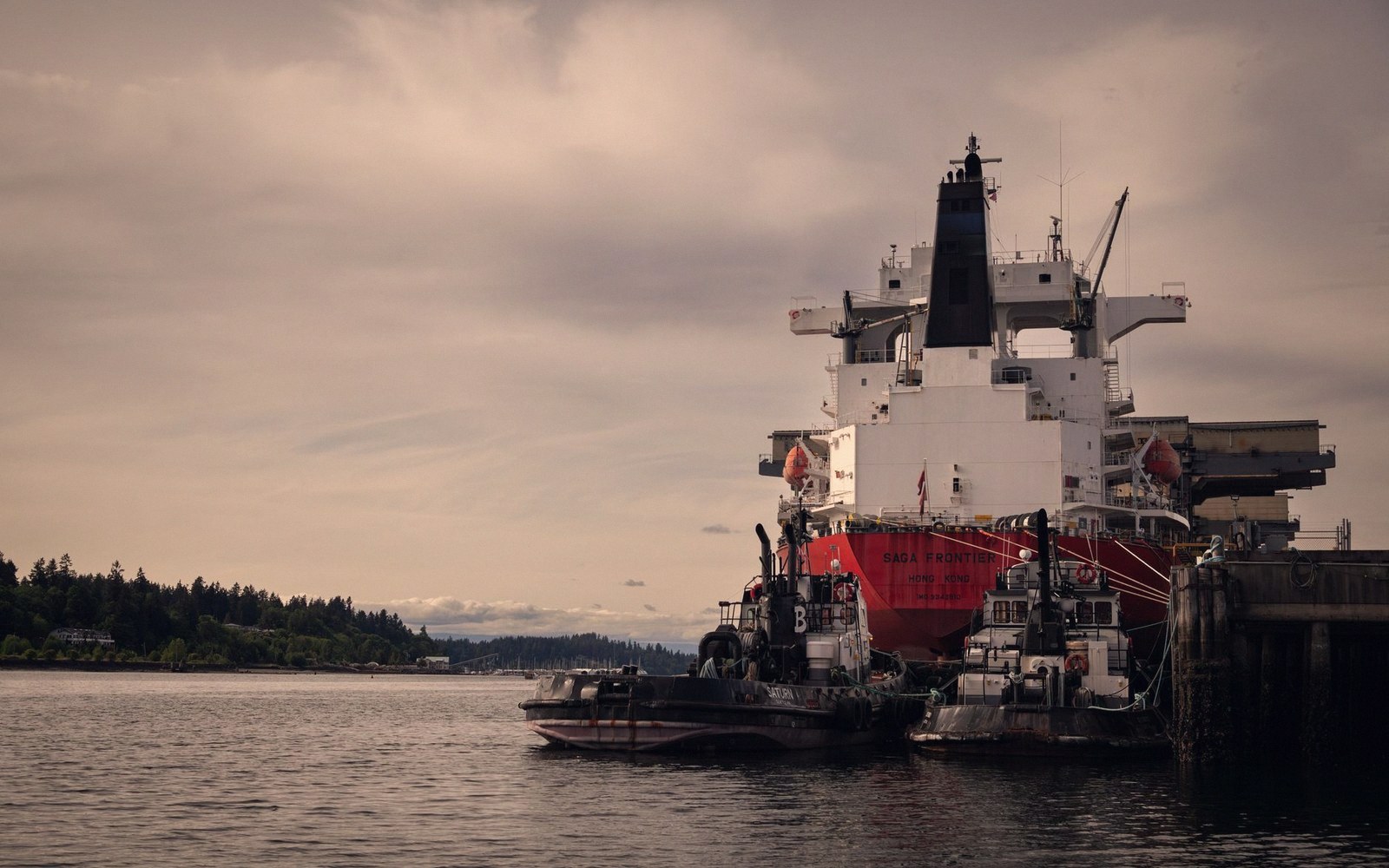
The arithmetic behind the water
When a ship enters a port, it must eventually leave — and most vessels cannot simply reverse out the way they came. The solution is a turning basin: a deliberately widened area of water, usually at the end of a channel or close to the berths, sized to let a vessel rotate roughly on its own axis before departing bow-first.
The standard planning rule sets the basin's diameter at between 1.2 and 1.5 times the vessel's overall length. A container ship of 350 metres therefore needs a swept circle somewhere between 420 and 525 metres across. That is not a number chosen arbitrarily — it reflects the turning radius achievable with tug assistance and slow thruster work, where forward speed is effectively zero and the ship pivots rather than steers.
Tugs apply lateral force at bow and stern, working in opposition to rotate the hull while the pilot on the bridge coordinates the engine and rudder to hold the pivot point roughly amidships. The manoeuvre can take twenty minutes for a large vessel. Wind and current make every rotation slightly different, which is why the basin must be sized for the worst-case combination of those conditions, not the average.
The geometry is never settled. Each generation of vessel arrives larger than the last — the draft deeper, the beam wider, the overall length longer — and basins dredged for one era of shipping are often inadequate for the next. Ports respond by either deepening and widening the basin or restricting which vessels can turn unassisted. The water looks still. The arithmetic underneath it never stops moving.