Rope, Angle and the Physics of Staying Put
A ship at a berth looks fixed. It sits against the quay, gangway lowered, cargo flowing — the image of stillness. From the dock, the lines holding it there appear to be the simplest part of the operation: thick ropes, tied off on bollards. They are not simple. A large vessel exerts enormous, direction-shifting forces on its mooring arrangement, and the geometry of those lines is the entire answer to a continuously changing problem.
The basic vocabulary is worth fixing before the physics. A mooring arrangement typically uses three categories of line, each doing different work. Headlines and sternlines run from the bow and stern toward the quay, at a shallow angle to the ship's centreline; their job is to prevent the vessel from moving forward or aft along the berth. Breast lines run nearly perpendicular from the ship's side to the dock, resisting the tendency of the hull to move away from the quay — that is, they hold the ship laterally, preventing it from drifting out. Spring lines run diagonally along the ship, an aft spring from a forward fitting toward a dock bollard astern of it, and a forward spring from an aft fitting toward a bollard forward — the crossed geometry means springs resist movement in both longitudinal directions simultaneously, and they do it more effectively at longer distances than headlines alone.
What each line can actually resist depends almost entirely on its angle relative to the force being applied. A breast line running ninety degrees off the hull absorbs lateral loads with full efficiency; ask the same line to hold the ship against a current pushing it along the berth and most of its strength is wasted. Angle is load distribution made visible.
The forces a berthed ship deals with are various and constantly shifting. Current is the most consistent source: a tidal river running beneath a vessel at three knots exerts pressure on the entire underwater body, a slab of water moving against thousands of square metres of wetted hull. Wind acts on the exposed topsides and superstructure — a container ship loaded to its upper tiers has an enormous windage area, and a forty-knot beam wind pushes against it with force measurable in the tens of tonnes. Propeller wash from passing traffic, a phenomenon dockhands call surge, produces sudden transient loads that spike and release faster than a line can adjust.
None of these forces is static. Tidal current reverses, sometimes twice in twelve hours. Wind veers and strengthens. A vessel that was lying comfortably against a current holding it onto the berth may, an hour later, find that same current reversed and trying to pull it away from the quay. An arrangement of six lines that was nearly redundant under one condition becomes genuinely strained under another. This is why mooring plans are not improvised at the last moment: they are agreed in advance, they specify line placement and the order in which lines are taken and let go, and they account for the tidal conditions expected during the ship's time alongside.
The lines themselves are made from materials with meaningfully different properties. Nylon stretches substantially before it parts, absorbing shock loads like a spring — useful against surge, but the recoil when a nylon line fails is violent. Polyester has less stretch and holds its strength when wet; it is common for breast lines where steady load matters. High-modulus synthetic fibres, often referred to under trade names but generically called HMPE, have very low elongation and very high strength-to-weight ratios; they are increasingly used for long lines on large vessels because they transmit load quickly without the snap-back energy of nylon. Each material requires slightly different handling and inspection, since the failure modes differ.
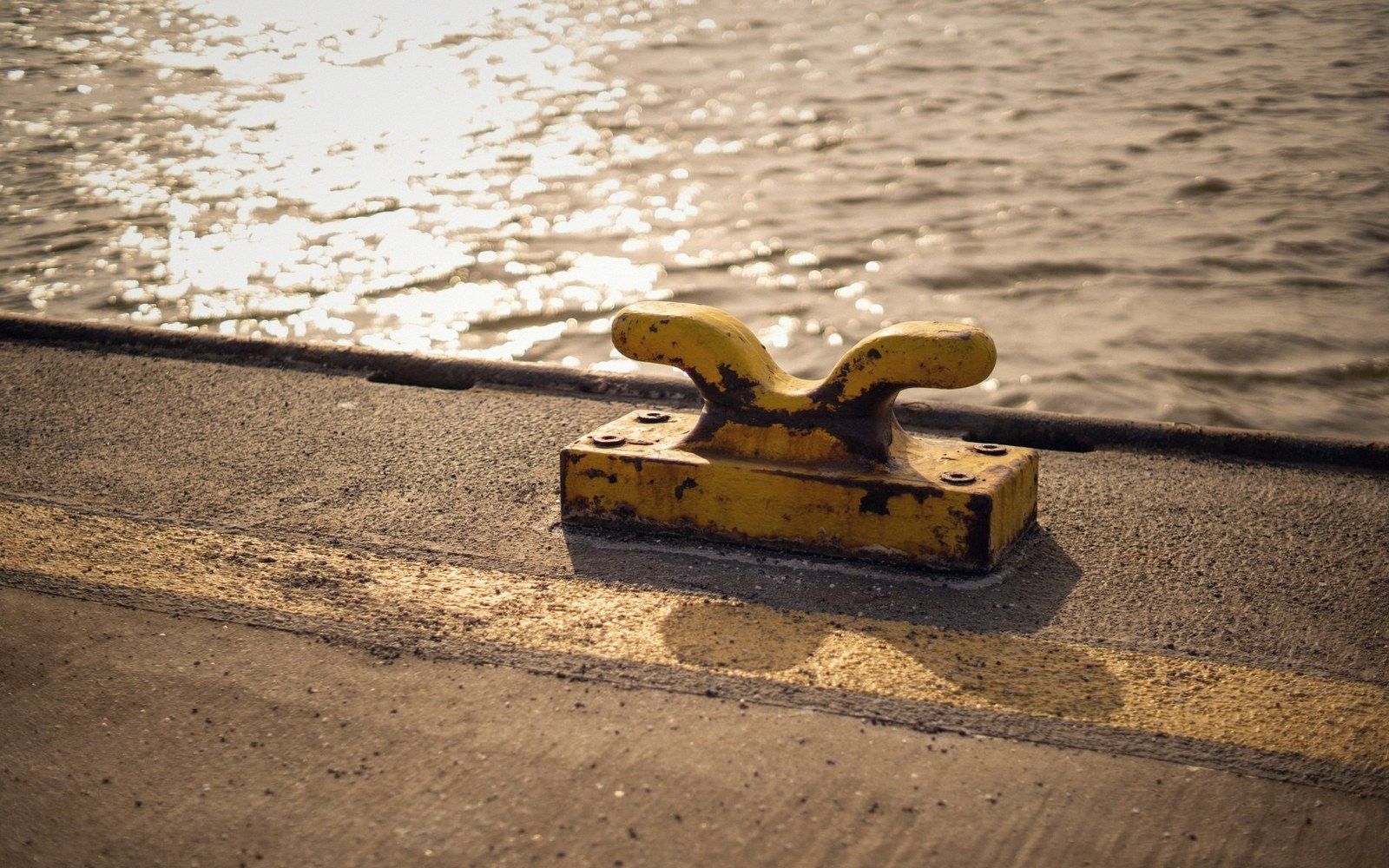
The bollard on the quay is also part of the equation. Bollards are rated by the load they can take — typically expressed as the maximum line pull in tonnes — and a mooring plan is only as good as the match between the forces being managed and the rated capacity of the hardware receiving them. A single bollard shared by two lines under high load is a common source of difficulty; the lines can interact and jam, making them hard to let go quickly when the ship needs to depart.
The effect of water depth under the keel adds one more variable. As the tide rises, a ship rises with it; as it falls, the ship settles. If the lines are not tended — slackened or hauled in to account for the change in water level — they begin to work against the vertical movement rather than allowing it. A headline that was correctly angled at high water may, at low water, be pulling downward on the bow fitting rather than horizontally toward the bollard. Fittings are stressed in directions they were not designed for. In a port with a large tidal range, this tending of the lines is not optional maintenance: it is continuous work, delegated to the deck watch and logged as part of the vessel's routine alongside.
From the quayside the ropes still look like ropes. The physics behind them is geometry, materials science and an ongoing negotiation between a floating object weighing tens of thousands of tonnes and whatever the tide and wind are doing that hour.