The Roundabout in the Middle of the Sea
A shipper in Sri Lanka sends electronics to a buyer in West Africa. The box leaves Colombo, calls at a port in the Middle East or along the Malacca Strait, then boards a second vessel entirely before continuing south and west. It never took the direct route, because for most of its journey, no direct route existed that made commercial sense. What it used instead was a transshipment hub: a port whose primary purpose is not to receive cargo on behalf of its own economy but to reload that cargo onto different ships bound for places the first vessel could not profitably reach.
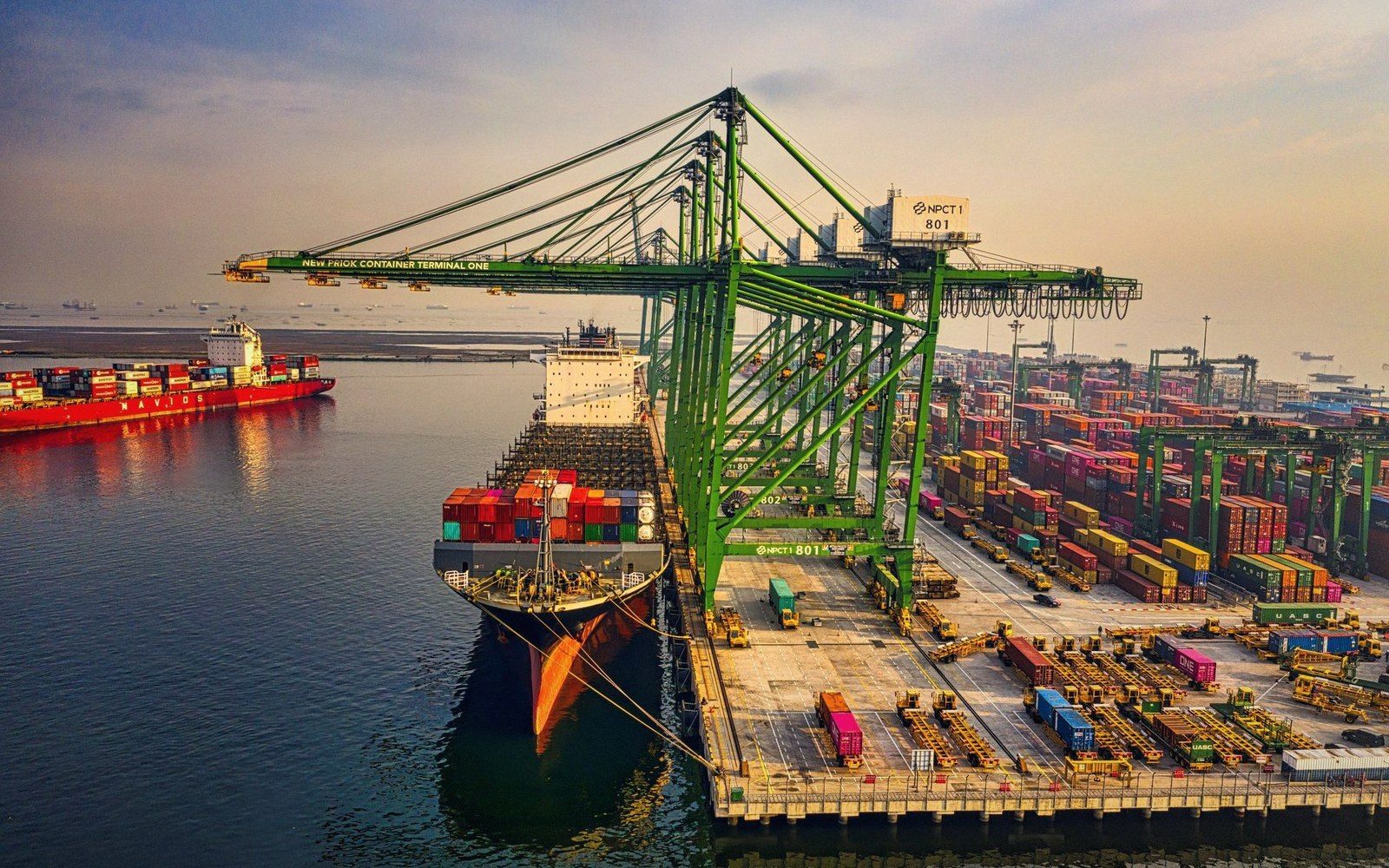
Transshipment is the act of transferring a container from one ship to another at an intermediate port. The first vessel — typically a large mainline carrier operating a fixed loop between major continents — calls at the hub and offloads boxes destined for regions it will not visit. A feeder vessel, smaller and slower, then picks those boxes up and distributes them to the smaller ports along the coast or up the river. The hub never consumes the cargo. It simply holds it, often for a matter of days, between the two legs of a journey.
The economics explain the geometry. A very large container ship, carrying ten or fifteen thousand boxes, cannot call economically at every port along a coastline. The cost of a port call — pilotage, towage, berth fees, time — is fixed regardless of how many boxes it lands. The ship earns its keep by keeping its slots full across long ocean passages, not by making frequent shallow diversions. So the mainline vessel concentrates its calls at a small number of deep-water hubs, and a network of feeder services fans out from those hubs to reach the wider region. The container gets where it is going; the big ship never departs from its efficient arc.
What Makes a Port a Hub
Not every port can become a transshipment centre. The geography has to work. A hub needs deep water — vessels of the largest class draw fifteen or sixteen metres — and it needs to sit close to a high-volume shipping lane, not off to one side of it. Every diversion from a mainline route costs fuel and time, so a hub that ships must significantly detour to reach is a hub that loses traffic to a better-placed rival.
Colombo in Sri Lanka, Port Klang and Tanjung Pelepas in Malaysia, Salalah in Oman, Algeciras at the western mouth of the Mediterranean, and Tanger Med just across the strait in Morocco — these are not coincidentally busy. Each sits astride a route that large vessels are already transiting. The mainline ship adds an hour or two to its schedule rather than a full day.
What a port authority or terminal operator builds on top of that geography is the infrastructure to turn boxes fast. Transshipment depends on crane productivity, yard organisation, and vessel scheduling tight enough that a feeder ship's slot at the quay aligns with the arrival of the mainline cargo it has come to collect. A hub where boxes sit for two weeks waiting for their feeder connection is a hub that shippers and carriers will eventually route around. Speed through the yard is the product being sold.
Some hubs have grown to the point where transshipment cargo dwarfs domestic import and export combined. Singapore handles tens of millions of twenty-foot equivalent units — TEUs, the standard unit of container count — annually, and a substantial share of that volume is cargo simply passing through. The port's economy is built as much on the transit fee, the bunker fuel sold to vessels in port, and the logistics services clustered around it as on any goods consumed by Singapore itself.
The consequence for a shipper is that the route taken by a container is rarely the shortest line on a map. It is the line that intersects the deepest water, the busiest lanes, and the most reliable onward connections. A box moving between two neighbouring countries may pass through a third not because of inefficiency but because that is exactly how geography and vessel economics have carved the world's trade routes. The hub is the logic made visible: a place built entirely around the movement of things that were never meant to stay.