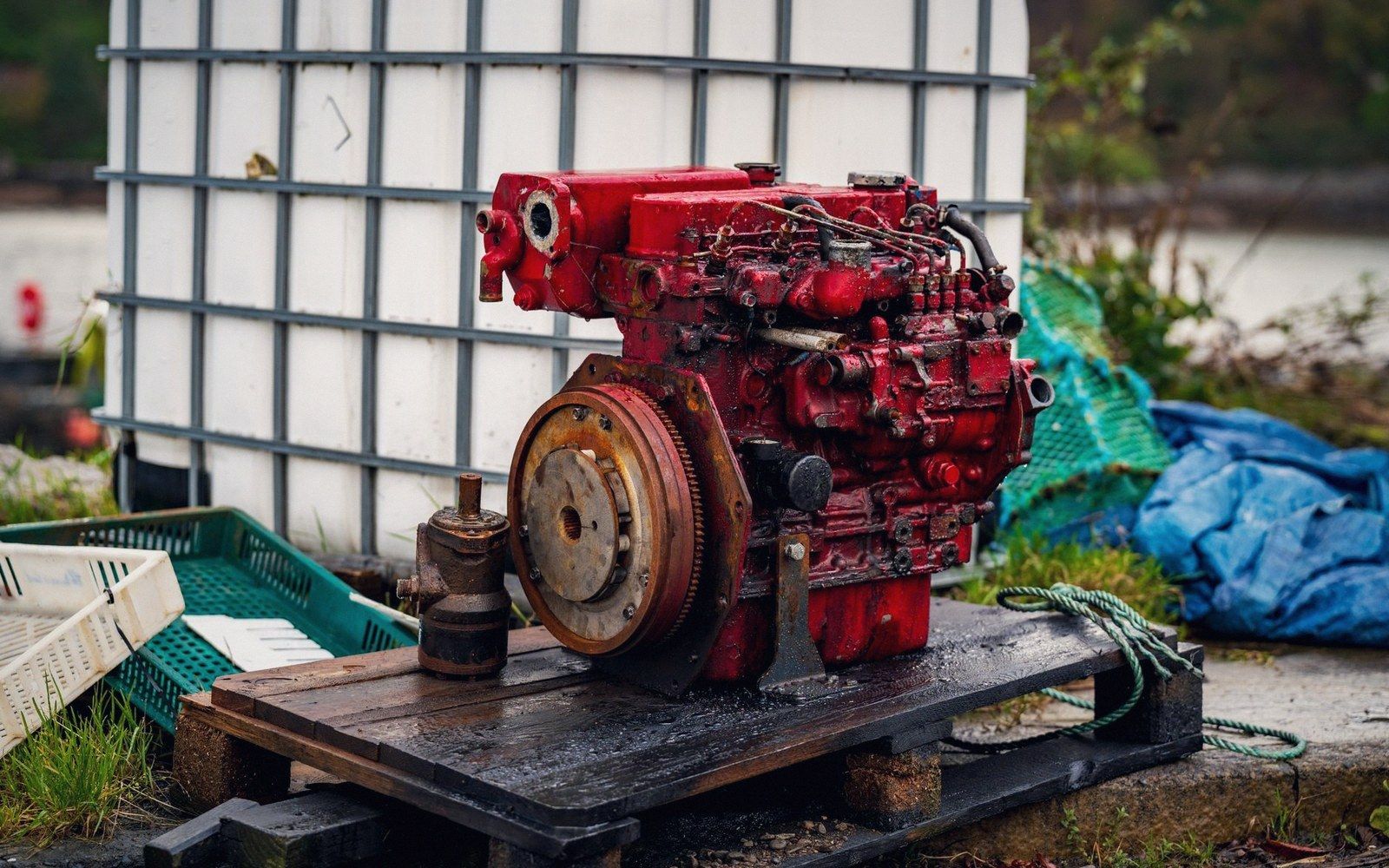
A Different Kind of Power
Walk past any car or truck and you have a rough intuition for how its engine behaves: high revs, compact size, a sound that rises and falls with the accelerator. The engine buried deep in the hull of a large bulk carrier or container ship operates on entirely different principles, and most of the things that feel wrong about it — the slowness, the size, the single fuel charge that drives a piston down a stroke of some two and a half metres — are not flaws. They are the reason ocean shipping works.
The engine in question is the two-stroke slow-speed diesel, and the largest examples currently in service are the most powerful internal combustion engines ever built. The Wärtsilä-Sulzer RT-flex96C and the MAN B&W ME-C series in their largest configurations produce outputs measured in the tens of thousands of kilowatts from a single engine block. For comparison, a Formula 1 power unit produces under a megawatt. These marine engines produce fifteen to eighty times that figure, depending on the configuration, and they do it while turning the crankshaft at somewhere between eighty and one hundred revolutions per minute — roughly the speed at which a person walks.
That rotational speed is not an oversight. It is the central engineering choice from which everything else follows.
How Two Strokes Differ from What You Know
Most people's only encounter with a two-stroke engine is a small outboard motor or a chainsaw: lightweight, aggressive, cheap to make and hard on fuel. The two-stroke principle — in which the piston completes a power cycle in a single up-and-down movement rather than the four strokes of a car engine — sounds like it ought to produce a frenetic, high-revving machine. In a small engine it does. In a marine slow-speed diesel, the same thermodynamic principle produces something closer to a geological event.
The difference lies in scale and in what the engine is asked to do. A car engine produces torque by spinning very fast and relying on the transmission to multiply the force. A large marine two-stroke produces torque by having an enormous bore — the diameter of the cylinder — and an equally enormous stroke, the distance the piston travels. The Wärtsilä RT-flex96C has a cylinder bore of 960 millimetres. Nearly a metre across. The stroke is roughly 2.5 metres. Each piston weighs several tonnes. When the fuel ignites above that piston, the force pressing down on the crankshaft is correspondingly vast.
Because each cylinder is so large, the engine does not need to fire rapidly to move a great deal of fuel and air through the combustion cycle. A slow crank speed is sufficient. And a slow crank speed has a critical consequence: it means the engine's output shaft can be coupled directly to the propeller shaft without a gearbox.
This matters enormously. A gearbox capable of handling the power of a large marine engine would itself be a substantial and expensive piece of machinery. It would introduce mechanical losses — energy turned into heat rather than thrust. And it would add a component that could fail. The direct-drive arrangement, made possible only because the engine turns slowly enough to match the ideal propeller speed, eliminates all of this. The crankshaft and the propeller shaft are effectively the same shaft. When the engine turns once, the propeller turns once.
What Happens Inside the Cylinder
The combustion sequence in a large two-stroke differs from a car engine in another important respect: the piston's function is separated into two distinct mechanical parts. In most slow-speed two-strokes used in ships, the engine is of the crosshead type. The piston rod does not connect directly to the crankshaft but to a crosshead — a sliding bearing running in vertical guides — which in turn connects via a connecting rod to the crankshaft. This arrangement allows the piston and cylinder to remain straight and aligned regardless of the angle of the connecting rod, which swings through a wide arc as it follows the crank.
The crosshead design makes the engine tall — these machines commonly stand ten to fifteen metres high — but it isolates the combustion space from the crankcase below, allowing different lubricating oils to be used in each area. Cylinder lubricants for a large two-stroke are specially formulated, alkaline greases fed in metered doses directly to the cylinder wall; crankcase oil is a separate system entirely. This separation, inconceivable in a small engine, allows each lubrication regime to be optimised for the very different conditions it faces.
Fuel injection in modern engines of this type is electronically controlled, replacing the older mechanical cam-driven systems. The Wärtsilä RT-flex series and the MAN ME-C series both use common-rail fuel injection — a technology familiar from modern diesel cars but applied here at a scale and pressure that dwarfs the automotive version. Electronic control allows the engine management system to vary injection timing, duration and pressure precisely, adjusting combustion to suit the load on the engine, the grade of fuel being burned, or the need to reduce exhaust emissions.
The Fuel, and Why It Matters
The fuel grades available to a large ship's engine span a wide spectrum, and the slow-speed diesel has historically been designed to burn the cheapest, heaviest grades available: heavy fuel oil, sometimes called bunker fuel or residual fuel, which is essentially the thick, viscous residue left after lighter fractions have been refined away from crude oil. A car engine would seize on such fuel within seconds. A large slow-speed diesel can run on it for years, provided the fuel is heated to reduce its viscosity before injection and the cylinder lubrication is correctly dosed.
The slow rotational speed is part of why this works. There is more time, in each combustion cycle, for the fuel to atomise and ignite cleanly. The large combustion chamber provides more space for combustion to complete before the piston descends. The thermodynamic efficiency of a large slow-speed diesel running on heavy fuel can reach fifty-five percent — meaning that more than half the energy in the fuel is converted into useful mechanical work. No other internal combustion engine type comes close. A good car petrol engine achieves around thirty-five to forty percent. The slow-speed marine diesel is, on this measure, the most efficient internal combustion engine built for commercial service.
Size, Range and What It Means for Cargo
The physical dimensions of these engines define the ships built around them. The engine room of a large container ship is not a room in any domestic sense; it is a full-height industrial space occupying the rear portion of the hull, with the engine block as its centrepiece. The block cannot be removed once the ship is built — the hull is constructed around it. Routine maintenance must therefore be carried out in situ, with pistons and cylinder heads lifted out vertically using the overhead crane that is part of every engine room's permanent equipment.
Because the engine turns slowly, and because it is directly coupled to the propeller, the propeller itself is large — typically six to ten metres in diameter on a large deep-sea vessel. A large, slow propeller is far more efficient than a small, fast one: it moves a greater volume of water with each revolution, generating thrust with less turbulent energy loss. The combination of a slow-speed engine driving a large propeller is what allows a vessel of two hundred thousand tonnes to cross an ocean on a single bunker load, achieving a fuel consumption per tonne-mile that is vastly more efficient than any alternative freight mode.
The engine watch in the engine control room monitors this system continuously: temperatures, pressures, cylinder performance, exhaust temperatures and lubrication flow. The engine is not supervised from beside the engine itself — it is too loud and too large for any useful direct attendance — but from a soundproofed room one deck removed, where the instrumentation aggregates the condition of thousands of individual components into a readable display. When something changes, the engineer responds. The engine, meanwhile, turns at walking pace, as it has been doing since the vessel left port, and will continue to do until the order comes to slow or stop.