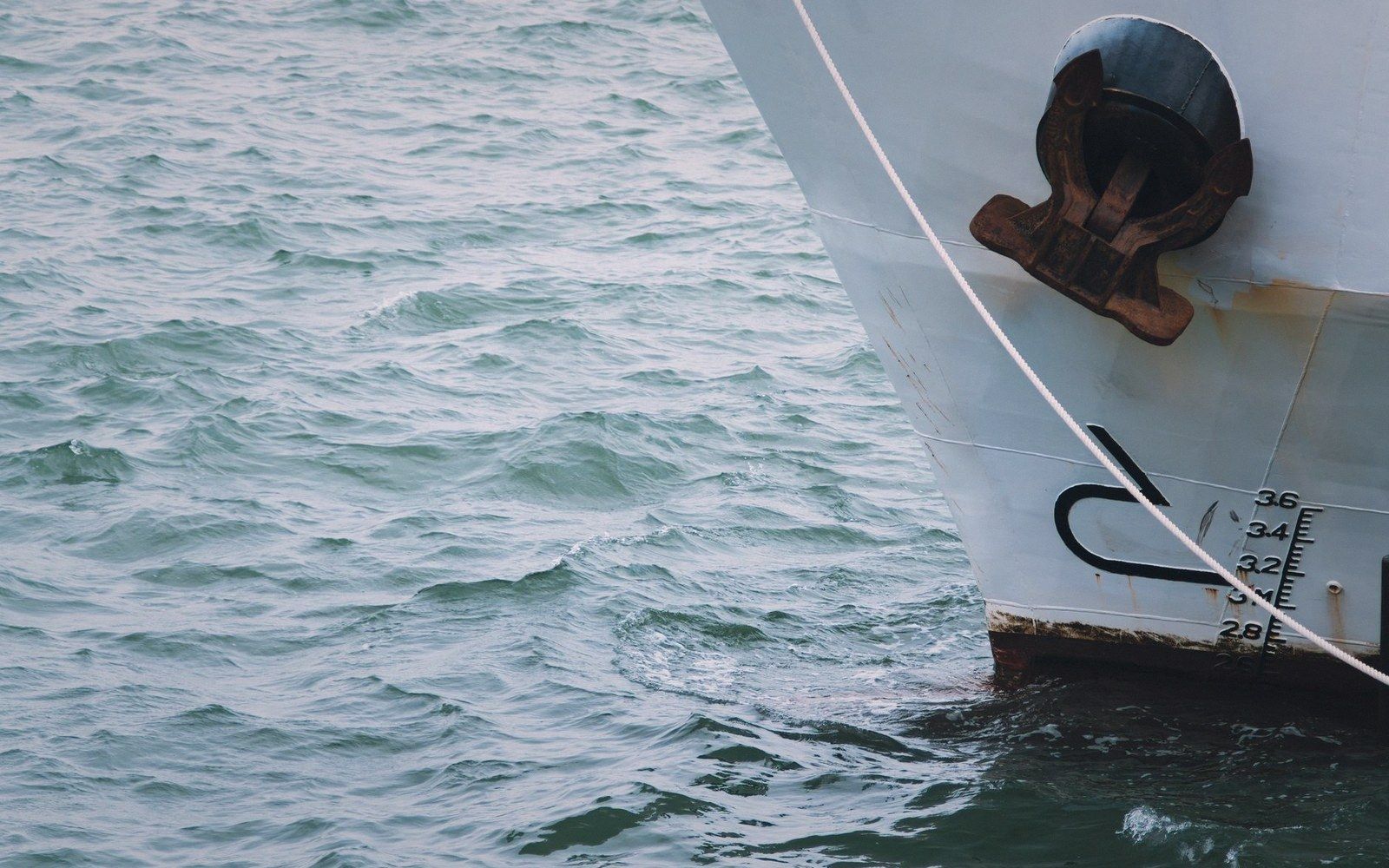
The Arithmetic of Lying at Anchor
Dropping the hook — as it is known on any working vessel — is one of the oldest operations in seafaring, and one of the most misunderstood from the outside. The anchor itself does relatively little work. The chain, called the cable, is where the holding force actually lives.
The principle is scope: the ratio of cable paid out to the depth of water beneath the hawse pipe — the fitting where the cable exits the hull at the bow. A short scope runs almost vertically, yanking the anchor upward rather than dragging it along the seabed; the anchor breaks out of the bottom and the ship drags. A long scope runs at a shallow angle, so the pull on the anchor is nearly horizontal, pressing the flukes — the digging surfaces — deeper into the seabed rather than lifting them. For most conditions, officers calculate a scope ratio of around five or six to one: five to six metres of cable for every metre of depth, measured from hawse pipe to bottom. In strong winds or open roadstead conditions — an exposed anchorage not sheltered by harbour walls — that ratio increases.
Depth alone doesn't fix the calculation. The officer also accounts for the rise and fall of the tide and the vessel's distance from any obstruction, because the ship will swing in a full circle as wind and current shift around it. The swinging circle's radius is roughly equal to the cable length paid out plus the ship's own length. Getting this wrong means swinging into another vessel or onto a shoal — a shallow patch that may not be obvious at high water.
Holding ground is the term for what the seabed actually offers. Soft mud holds badly; the anchor skids rather than bites. Sand and mixed clay hold well. Shingle is treacherous. Rocky ground may grip initially but damages the cable and can foul the anchor — jam it so tightly that recovery requires careful manoeuvring to break the angle of pull. The character of the bottom is marked on charts, abbreviated in a notation that bridge officers read routinely.
Once the cable is paid out and the brake on the windlass — the powered winch that handles the chain — is set, the ship is not stationary. It shears slowly back and forth on the cable, and the chain hangs in a curve called a catenary rather than a straight line; it is that curve, absorbing the ship's movement, that prevents the anchor from being jerked free. A vessel at anchor still requires a watchkeeper monitoring its position against fixed points, running regular checks to confirm it hasn't dragged. The ship is resting. The watch is not.